What Is a Derivative Work of Digital Art That Is Not Layable to Copyright


Artists copying the "Mona Lisa". The original flick is in the public domain, only both the derivative work (the re-create of the picture) and this photograph would attract their own copyright. The artists and lensman were working for the copyright holder, who has released the rights under a "CC BY-SA ii.0" license.
In copyright constabulary, a derivative work is an expressive creation that includes major copyrightable elements of an original, previously created first work (the underlying piece of work). The derivative work becomes a second, split work contained in form from the first. The transformation, modification or adaptation of the piece of work must be substantial and bear its author's personality sufficiently to be original and thus protected by copyright. Translations, cinematic adaptations and musical arrangements are common types of derivative works.
Most countries' legal systems seek to protect both original and derivative works.[1] They grant authors the correct to impede or otherwise control their integrity and the author's commercial interests. Derivative works and their authors benefit in turn from the total protection of copyright without prejudicing the rights of the original work's writer.
Definition [edit]
Berne [edit]
The Berne Convention for the Protection of Literary and Creative Works, an international copyright treaty, stipulates that derivative works shall be protected although it does not employ the term, namely that "Translations, adaptations, arrangements of music and other alterations of a literary or artistic work shall be protected as original works without prejudice to the copyright in the original work".[2] [ improve source needed ]
United States [edit]
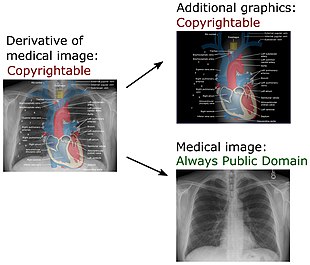
In U.Due south. law, this derivative work of a breast radiograph (which is in the Public Domain) is copyrightable because of the additional graphics. All the same the chest radiograph component of the piece of work is still in the Public Domain.
An all-encompassing definition of the term is given by the U.s. Copyright Human activity in 17 United states of americaC. § 101:
A "derivative piece of work" is a work based upon one or more preexisting works, such as a translation, musical organization, dramatization, fictionalization, motility motion picture version, sound recording, fine art reproduction, abridgment, condensation, or any other form in which a work may be recast, transformed, or adjusted. A work consisting of editorial revisions, annotations, elaborations, or other modifications which, equally a whole, stand for an original piece of work of authorship, is a "derivative work".
17 U.Southward.C. § 103(b) provides:
The copyright in a compilation or derivative work extends simply to the textile contributed past the author of such work, as distinguished from the preexisting material employed in the piece of work, and does not imply any exclusive right in the preexisting fabric. The copyright in such work is independent of, and does non bear on or overstate the telescopic, duration, ownership, or subsistence of, any copyright protection in the preexisting textile.
17 U.Southward.C. § 106 provides:
Subject to sections 107 through 122, the owner of copyright under this championship has the sectional rights to do and to authorize any of the following:
(ane) to reproduce the copyrighted work in copies...;
(2) to ready derivative works based upon the copyrighted work;
(3) to distribute copies...of the copyrighted work to the public by sale or other transfer of ownership, or by rental, charter, or lending....
US Copyright Office Circular 14: Derivative Works notes that:
A typical example of a derivative work received for registration in the Copyright Function is one that is primarily a new work merely incorporates some previously published material. This previously published material makes the piece of work a derivative piece of work nether the copyright police force. To exist copyrightable, a derivative work must be dissimilar enough from the original to be regarded every bit a "new work" or must contain a substantial amount of new textile. Making minor changes or additions of little substance to a preexisting work will not authorize the work equally a new version for copyright purposes. The new fabric must be original and copyrightable in itself. Titles, short phrases, and format, for case, are not copyrightable.
The statutory definition is incomplete and the concept of derivative work must be understood with reference to explanatory case police. Three major copyright law issues arise apropos derivative works: (1) what acts are sufficient to crusade a copyright-protected derivative work to come into existence; (2) what acts constitute copyright infringement of a copyright in a copyright-protected work; and (3) in what circumstances is a person otherwise liable for infringement of copyright in a copyright-protected derivative work excused from liability past an affirmative defense, such as starting time sale or off-white utilize?
Eu [edit]
French law prefers the term "œuvre composite" ("blended piece of work") although the term '"œuvre dérivée" is sometimes used. It is divers in article L 113-2, paragraph 2 of the Intellectual Property Code every bit "new works into which pre-existing work [is incorporated], without the collaboration of its author".[3] The Court of Cassation has interpreted this statute as requiring two distinct inputs at different points in fourth dimension.[4]
The Court of Justice of the European Union in 2010 decided on a affair of derivative works in Systran v. European Committee (Instance T‑nineteen/07[5]). However, it was overturned in 2013[six] based on the conclusion that the case did not fall within the Full general Court's jurisdiction, after terminal that the dispute had been of a contractual nature, instead of a non-contractual 1.
Canada [edit]
Though Canadian copyright law does not explicitly define "derivative work", the Copyright Human activity of Canada does provide the following generally agreed-upon[seven] [8] examples of what constitutes a derivative work in section three:
"copyright"...includes the sole correct
(a) to produce, reproduce, perform or publish whatever translation of the work,
(b) in the case of a dramatic work, to catechumen it into a novel or other non-dramatic piece of work,
(c) in the example of a novel or other non-dramatic piece of work, or of an artistic work, to convert it into a dramatic piece of work, by way of performance in public or otherwise,
(d) in the example of a literary, dramatic or musical work, to make any sound recording, cinematograph picture or other dodge by means of which the work may be mechanically reproduced or performed,
(e) in the case of any literary, dramatic, musical or creative work, to reproduce, conform and publicly nowadays the work equally a cinematographic work
In Théberge five. Galerie d'Fine art du Petit Champlain Inc., [2002] 2 Southward.C.R. 336, 2002 SCC 34, the Supreme Court of Canada clarified the statutory recognition of derivative works extended only to circumstances where at that place was product and multiplication, i.east. reproduction. Where in that location is no derivation, reproduction, or production of a new and original work which incorporates the artist's work, at that place is no violation of the Copyright Human activity.
Significance, history and social context [edit]
Derivative works represent the majority of the man cultural, scientific and technological heritage, as exemplified past the maxim about "continuing on the shoulders of giants."[9] The number of derivative works has been adversely impacted by the introduction of the copyright constabulary, which fabricated them illegal in numerous circumstances, and positively by the spread of the copyleft ethos in the concluding 20th and early on 21st century.[10] [11] [12] : 62
Application of derivative-work copyright [edit]
Originality requirement [edit]
For copyright protection to attach to a subsequently, allegedly derivative work, information technology must brandish some originality of its ain. It cannot be a rote, uncreative variation on the earlier, underlying piece of work. The latter piece of work must contain sufficient new expression, over and above that embodied in the earlier work for the latter work to satisfy copyright law's requirement of originality.
Although serious emphasis on originality, at least and so designated, began with the Supreme Courtroom's 1991 decision in Feist v. Rural, some pre-Feist lower court decisions addressed this requirement in relation to derivative works. In Durham Industries, Inc. 5. Tomy Corp. [13] and before in 50. Batlin & Son, Inc. 5. Snyder.[14] the 2nd Circuit held that a derivative piece of work must be original relative to the underlying work on which information technology is based. Otherwise, it cannot enjoy copyright protection and copying it will not borrow any copyright of the derivative work itself (although copying it may borrow the copyright, if whatever, of the underlying piece of work on which the derivative work was based).
The Batlin example rested on the copyrightability of an "Uncle Sam" toy banking concern, first copyrighted in 1886. These toys have Uncle Sam's extended arm and outstretched paw adapted to receive a coin; when the user presses a lever, Uncle Sam appears to put the coin into a carpet handbag. Ane maker of these banks, Jeffrey Snyder, had filed a copyright on such a bank in 1975, planning to import them for the American Bicentennial. Soon thereafter, some other visitor, L. Batlin & Sons, Inc., besides began making a very similar toy bank which was based on Snyder'south version (and not, incidentally, on the 19th century original). When the latter attempted to import the toy banks, the United states of america Customs service notified them that they appeared to exist infringing on Snyder's copyright, and would non let the toy banks to be imported. Batlin then got an injunction against Snyder to deny the recording of his copyright and allowing them to import their banks. On appeal to the Second Circuit Courtroom, Snyder took not bad pains to demonstrate how his banks varied in size and shape from the 19th century original, arguing that his banks, though like to the older work, differed in a number of pregnant means and warranted protection under a new copyright. However, his appeal was denied and the injunction against Snyder's copyright upheld (6 members of the court voted to deny, the other three filing a dissenting opinion). Much of this decision focused on the fact that well-nigh all of the alterations in Snyder's version were fabricated solely to allow the object to be more hands manufactured in plastic rather than metal, and therefore were functional, non artistic or creative.[fifteen] [16] "To extend copyrightability to minuscule variations would merely put a weapon for harassment in the hands of mischievous copiers intent on appropriating and monopolizing public domain work." The event was not whether or not Batlin's depository financial institution was a copy of Snyder's— information technology undoubtedly was— but whether or not Snyder could claim copyright protection, which the court decided he could not.
In the subsequent Durham case, the court applied the same principle in a adjust between two different Disney toy licensees in which one licensee claimed that the other had pirated his Mickey Mouse, Donald Duck and Pluto. Durham conceded that in making these toys it used Tomy's Disney figures as models. That was non determinative. The court said that "the only aspects of Tomy'due south Disney figures entitled to copyright protection are the not-trivial, original features, if any, contributed by the author or creator of these derivative works." Only Tomy's toys reflected "no independent creation, no distinguishable variation from preexisting works, naught recognizably the author's own contribution that sets Tomy's figures autonomously from the prototypical Mickey, Donald, and Pluto, authored by Disney and subsequently represented past Disney or its licensees in a seemingly limitless variety of forms and media." Because the court considered that "it is clear that the originality requirement imposed by the Constitution and the Copyright Act has particular significance in the instance of derivative works based on copyrighted preexisting works," information technology denied relief and dismissed the merits. Thus the law is clear that a derivative work is protectable merely to the extent that information technology embodies original expression. Its not-original aspects are not copyright-protectable (what is loosely chosen "uncopyrightable").
In both of these cases, the defendants were held non to be liable for copyright infringement, fifty-fifty though they presumably copied a considerable corporeality from the plaintiff'southward work. They were non liable because the plaintiff did not enjoy copyright protection. The plaintiffs' works lacked plenty originality to larn copyright protection of their ain. They were too close to the original works on which they were based.
Lawful works requirement [edit]
Copyright ownership in a derivative work attaches only if the derivative work is lawful, because of a license or other "authorisation." The U.S. Copyright Office says in its circular on derivative works:
In any case where a copyrighted work is used without the permission of the copyright owner, copyright protection volition not extend to any part of the piece of work in which such textile has been used unlawfully.[17] [18]
The courts take so far addressed lilliputian attending to the result of lawful (i.east., not unlawful) use without potency, as in off-white-apply cases such every bit the Pretty Woman instance. Recently, however, in Keeling v. Hars,[xix] the Second Circuit held that, if the creator of an unauthorized work stays within the bounds of off-white employ and adds sufficient original content, the original contributions in such an unauthorized derivative work are protectable nether the Copyright Human action. In that instance, the plaintiff created a parody stage accommodation of a motion picture show, without authorization.
Liability of derivative-work [edit]
This issue sometimes arises in the context of the defendant purchasing a copy of a picture or some other work from the copyright owner or a licensee and then reselling it in dissimilar context. For example, pictures from greeting cards might be affixed to tiles or ane kind of textile product might be turned into another that can be sold at a higher cost. In Lee v. A.R.T. Co., (the Annie Lee case), the defendant affixed the copyright owner's copyright-protected notation cards and pocket-size lithographs to tiles and then resold them.[twenty] The original art was not changed or reproduced, only bonded to ceramic and sold. The courtroom held that this act was not original and creative plenty to rise to the level of creating a derivative work, but effectively like to any other grade of display or fine art frame.[21]
Distribution rights differ from reproduction rights. While the first-sale doctrine entitles the copyright holder to begin the distribution chain of a copyrighted piece of work - by selling note cards, for case, or giving them away - information technology does not permit the copyright holder to control what is done with the item afterwards it is distributed. Unless at that place is a separate contract between the parties, the person who owns the object has the right to give it abroad or resell it him or herself. In the case of Lee five. A.R.T., since bonding the cards to ceramic did not create a derivative piece of work, A.R.T. Co. was legally within their rights to resell the cards in such a fashion.
When the defendant's modification of the plaintiff's work is de minimis, also insubstantial to "count", at that place is no infringing training of a derivative work. So long equally at that place is no derivative work, there is no infringement—since no deport that the Copyright Human activity forbids has occurred.
Fixation requirement [edit]
In a House Report,[22] Congress said:
The exclusive right to prepare derivative works, specified separately in clause (ii) of section 106, overlaps the sectional right of reproduction to some extent. It is broader than that correct, even so, in the sense that reproduction requires fixation in copies or phonorecords, whereas the preparation of a derivative work, such as a ballet, pantomime, or improvised performance, may exist an infringement even though nothing is e'er stock-still in tangible form.
The 9th Excursion, even so, has resisted this expansive view of liability for derivative works past imposing its own quasi-fixation requirement. In Micro Star v. FormGen Inc. [23] Judge Kozinski wrote:
To narrow the statute to a manageable level, we accept developed sure criteria a work must satisfy in society to authorize every bit a derivative work. One of these is that a derivative piece of work must exist in a "concrete or permanent form,"....The requirement that a derivative piece of work must assume a concrete or permanent class was recognized without much discussion in Galoob.
The fair use defense force in derivative piece of work cases [edit]
Even if a work is found to be an unauthorized derivative work, an declared infringer can escape liability via the defense of fair use. For instance, in Campbell v. Acuff-Rose Music, Inc., the Supreme Court plant that although a parody of the song "Oh, Pretty Adult female" by 2 Alive Crew was an unauthorized derivative piece of work, fair use was nevertheless available as a complete defense. This instance marked the Supreme Court's pointing to transformativeness as a major clue to awarding of the fair utilize defense force to derivative works.
The defense of fair utilize has become very important in computer- and Internet-related works. 2 1992 Ninth Excursion decisions are illustrative.
In Lewis Galoob Toys, Inc. v. Nintendo of America, Inc.,[24] the appellate court held that it was a fair use for owners of copies of video games, such as Super Mario Bros., to utilise Galoob's product the Game Genie to customize the difficulty or other characteristics of the game by granting a graphic symbol more forcefulness, speed, or endurance. Nintendo strongly opposed Galoob's product, allegedly considering it interfered with the maintenance of the "Nintendo Civilisation," which Nintendo claimed was important to its marketing programme.[25] The courtroom held, among other things, that the fair use defense shielded Galoob's comport. The court said that "a political party who distributes a copyrighted work cannot dictate how that piece of work is to be enjoyed. Consumers may use ... a Game Genie to enhance a Nintendo Game cartridge's audiovisual brandish in such a way as to make the experience more enjoyable."
In Sega Enterprises, Ltd. five. Honour, Inc.,[26] the court excused Accolade from copyright infringement liability on fair use grounds. Nintendo and Sega produced video game consoles. Each stored the games in plastic cartridges that provided game data to the consoles. Past way of analogy, the Sega hardware console's "platform" differed from Nintendo's, as a Macintosh platform differs from that of a PC. Hence, a video game cartridge that works on one system does non piece of work on the other. Sega and Nintendo sought to "license" admission to their hardware platforms, and each visitor developed software "locks" to continue out cartridges that did not have the proper "primal." Accolade sought a license from Sega for its key, but negotiations bankrupt down over price. Accolade then decided to reverse engineer Sega's lock and key system. To do so, information technology had to download (re-create) all of the computer code from Sega's product and disassemble it (translate it from motorcar code into human-readable assembly). Accolade succeeded and began to market new video games that it independently wrote, which were capable of beingness operated in Sega consoles. This led to copyright infringement litigation, in which Sega alleged that the downloading was improper copying (reproduction) of Sega'southward code. The court held that Sega was trying to use the copyright in its reckoner code to maintain a monopoly over the sale of video games, to which it was not legally entitled. Accolade downloaded the computer code merely to ascertain how the lock worked, so that it could make a cardinal that would permit its games to work in Sega consoles. The courtroom held that such a use was fair use: "Nosotros conclude that where disassembly is the only mode to gain access to the ideas and functional elements embodied in a copyrighted estimator program and where there is a legitimate reason for seeking such access, disassembly is a fair use of the copyrighted work, as a matter of police."[27] However, note that since the passage of the anti-circumvention statutes contained in the DMCA, further court cases involving the off-white-use defense of such activities have however[ citation needed ] to exist actually litigated.
Transformativeness [edit]
A crucial factor in electric current legal analysis of derivative works is transformativeness, largely every bit a result of the Supreme Court'due south 1994 decision in Campbell v. Acuff-Rose Music, Inc. The Court'south stance emphasized the importance of transformativeness in its fair apply analysis of the parody of "Oh, Pretty Woman" involved in the Campbell case. In parody, every bit the Court explained, the transformativeness is the new insight that readers, listeners, or viewers gain from the parodic treatment of the original work. As the Court pointed out, the words of the parody "derisively demonstrat[due east] how banal and banal the Orbison [Pretty Woman] song" is.
The modern emphasis of transformativeness in fair utilise analysis stems from a 1990 article by Judge Pierre Due north. Leval in the Harvard Law Review, "Toward a Off-white Use Standard",[28] which the Courtroom quoted and cited extensively in its Campbell opinion. In his commodity, Leval explained the social importance of transformative employ of another'due south work and what justifies such a taking:
I believe the answer to the question of justification turns primarily on whether, and to what extent, the challenged use is transformative. The utilize must be productive and must employ the quoted affair in a different manner or for a different purpose from the original. ...[If] the secondary apply adds value to the original--if the quoted matter is used as raw fabric, transformed in the creation of new data, new aesthetics, new insights and understandings--this is the very type of activity that the off-white use doctrine intends to protect for the enrichment of club.
Transformative uses may include criticizing the quoted work, exposing the character of the original author, proving a fact, or summarizing an idea argued in the original in social club to defend or rebut it. They also may include parody, symbolism, aesthetic declarations, and innumerable other uses.
The concept, as Leval and the Campbell Court described it, developed in relation to fair apply of traditional works: literary works, musical works, and pictorial works. Just recently courts have extended this rationale to Internet and computer-related works. In such cases, as illustrated by Kelly v. Arriba Soft Corporation [29] and Perfect 10, Inc. v. Amazon.com, Inc.,[30] the courts observe a apply (such as that of thumbnails in an image search engine, for indexing purposes) transformative because it provides an added benefit to the public, which was non previously available and might remain unavailable without the derivative or secondary use. The Ninth Excursion Courtroom explained this in the Perfect 10 case:
Google's use of thumbnails is highly transformative. In Kelly we concluded that Arriba's apply of thumbnails was transformative because "Arriba'south use of the images served a dissimilar part than Kelly's use — improving admission to information on the Net versus creative expression." Although an image may accept been created originally to serve an entertainment, aesthetic, or informative office, a search engine transforms the prototype into a pointer directing a user to a source of information. Just every bit a "parody has an obvious claim to transformative value" because "information technology can provide social do good, by shedding low-cal on an earlier piece of work, and, in the process, creating a new 1," a search engine provides social do good by incorporating an original work into a new work, namely, an electronic reference tool. Indeed, a search engine may be more transformative than a parody considering a search engine provides an entirely new use for the original piece of work, while a parody typically has the same amusement purpose as the original piece of work.
…In conducting our case-specific analysis of fair use in light of the purposes of copyright, nosotros must weigh Google's superseding and commercial uses of thumbnail images against Google'south significant transformative use, as well as the extent to which Google's search engine promotes the purposes of copyright and serves the interests of the public. Although the commune court best-selling the "truism that search engines such as Google Image Search provide groovy value to the public," the district court did not expressly consider whether this value outweighed the significance of Google'south superseding utilize or the commercial nature of Google'south apply. The Supreme Court, still, has directed usa to be mindful of the extent to which a employ promotes the purposes of copyright and serves the interests of the public.
…We conclude that the significantly transformative nature of Google's search engine, specially in light of its public benefit, outweighs Google's superseding and commercial uses of the thumbnails in this case. … We are also mindful of the Supreme Court's direction that "the more than transformative the new work, the less will be the significance of other factors, like commercialism, that may counterbalance against a finding of fair use."
The Ninth Circuit's handling of transformativeness and off-white use in the Arriba Soft and Perfect 10 cases illustrates different information points on the copyright infringement spectrum, at least with respect to transformativeness and fair utilise. Arriba Soft was a relatively polar instance. The harm to Kelly, the copyright owner, was negligible; it was inappreciably more than than hurt feelings, because as the 9th Excursion said in its opinion – "Arriba's creation and use of the thumbnails [the derivative piece of work] does not harm the market for or value of Kelly' south images." On the other manus, the court constitute that Arriba's employ benefited the public: "Arriba's utilize of the images serves a different office than Kelly'due south use — improving access to data on the internet versus artistic expression." The residue thus tilted strongly in Arriba's favor. The foregoing assay in this instance thus fabricated the Ninth Circuit to be the commencement court to brand the equation highly beneficial to public = transformative, and as the Supreme Court explained in Campbell, the more transformative a derivative use the more likely the use is to be a off-white use.
The Campbell Court recognized that the balance may non always be one-sided, as it was in Campbell itself and in Arriba Soft. In the Perfect 10 instance the interests were more evenly balanced, for the showtime time in a derivative work case involving new information technology. Both Google and Perfect 10 had legitimate interests at stake and support for their respective positions. Thus, in that location was a finding that "Google's broad-ranging employ of thumbnails is highly transformative: their creation and display is designed to, and does, display visual search results quickly and efficiently to users of Google Image Search." Just Google's utilise had some commercial aspects and was claimed to impair P10'south commercial interests. However, on balance the Ninth Circuit found that the transformativeness outweighed the other fair employ factors considering "Google has provided a significant benefit to the public" in facilitating image searches by ways of thumbnail images. This opinion provided a 2d example of the "beneficial=transformative" equation described in the preceding paragraph (from the Arriba Soft example).

Screenshot of One-half.com popular-up ad over Amazon's Web folio c. 2008
The use of pop-up advertising, in which third-political party advertisements popular upward on a competitor's Web page and modify its appearance to allegedly create a derivative piece of work,[31] may nowadays transformativeness bug. The proponents of such pop-ups (the defendants in infringement litigation) debate that they provide the public with additional information most making buying decisions (particularly in the class of price comparisons), merely the opponents (the plaintiffs in these cases) contend that the defendants' conduct adversely affects the Spider web page proprietor's interest in the "integrity" of its Web folio and its investment interest in creating and maintaining the folio.[32]
An example of promotional advertising for a pop-upwardly company, illustrating various popular-up techniques for changing the appearance of another firm's Web page is shown in this Flash.[33]
Piddling attention has been paid to the balancing of the interests at stake in derivative work copyright disputes where conflicting interests are nowadays. In the Perfect 10 and Castle Rock cases, however, the courts appeared to have recognized that some disharmonize existed, just they finessed the balancing task by finding one side or the other's interest negligible, so that no serious work had to be done in gauging the balance. although several courts have found no copyright infringement for one reason or another. In an analogous area of copyright constabulary, a solution reached was to permit the use challenged as infringement, but to require payment of a reasonable royalty.[34]
Examples of derivative works nether U.Southward. constabulary [edit]
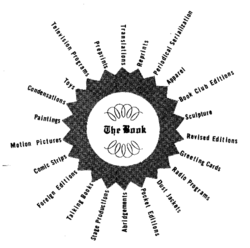
Graphic from the U.s.a. Copyright Function, 1959, giving examples of derivative works.
The most famous derivative work in the world has been said to be L.H.O.O.Q.,[35] also known equally the Mona Lisa With a Moustache. Generations of U.Due south. copyright law professors — since at least the 1950s — have used it as a paradigmatic instance. Marcel Duchamp created the piece of work by adding, amidst other things, a moustache, goatee, and the caption L.H.O.O.Q. (letters which phonetically resemble the phrase in French "She is hot in the ass") to Leonardo's iconic work. These few seemingly insubstantial additions were highly transformative because they incensed contemporary French bourgeoisie[36] by mocking their cult of "Jocondisme,"[37] at that time said to be "practically a secular religion of the French bourgeoisie and an important part of their self paradigm." Duchamp's defacement of their icon was considered "a major stroke of épater le bourgeois." Thus it has been said that the "transformation of a cult icon into an object of ridicule by adding a small quantum of additional material can readily be accounted training of a derivative work."[38] A parodic derivative work based on Duchamp's parodic derivative work is shown at this location.
The mockery of "Oh, Pretty Woman," discussed in Campbell v. Acuff-Rose Music, Inc., is a similar example of transforming a work past showing it in a harsh new lite or criticizing its underlying assumptions. Because of the parody's transformativeness, the Supreme Court institute the derivative work a off-white use.
Trivia books based on Boob tube shows, such every bit Seinfeld, are considered derivative works, for purposes of infringement liability, at least if they incorporate a substantial corporeality of copyright-protected content from the Tv set episodes.[39] In Castle Stone the courtroom plant that whatever transformative purpose possessed in the derivative work was "slight to non-existent." Appropriately, the court held that defendants had prepared an infringing derivative work.
A 2007 lawsuit, CBS Operations 5. Reel Funds International, ruled that tv set series that have some episodes lapse into the public domain can be classified as derivative works and discipline to indirect copyright accordingly. The lawsuit centered around 16 episodes of The Andy Griffith Show from the show's tertiary season that had lapsed into the public domain in 1989; CBS successfully argued that because all of the episodes from the show's start two seasons were however nether valid copyright, that CBS still held copyright on the characters used in those episodes and could block a public domain distributor from selling DVDs with those episodes.[forty] [41]
The musical West Side Story, is a derivative piece of work based on Shakespeare'southward Romeo and Juliet, because it uses numerous expressive elements from the before work.[42] Still, Shakespeare's drama Romeo and Juliet is also a derivative work that draws heavily from Pyramus and Thisbe and other sources. All the same, no legal rule prevents a derivative work from existence based on a work that is itself a derivative work based on a still earlier work — at to the lowest degree, so long as the last work borrows expressive elements from the second work that are original with the second work rather than taken from the earliest work. The key is whether the copied elements are original and expressive (not only conventional or mise en scène); if that is and then, the 2nd or derivative piece of work is independently subject to copyright protection, and if that is not, the 2nd piece of work (if unauthorized) may infringe the first, but information technology is not independently copyrightable.[43]
Pop-up advertising provides derivative works that tin be transformative,[44] in that they provide the public with new functionality not previously offered — they may provide comparative price information, for instance.[45] Yet, pop-ups may also impair interests of the proprietors of Web pages subjected to them. For example, the Half.com popular-up ad shown to a higher place left informs the public equally to toll competition between Half.com and Amazon.com. Merely the derivative-piece of work version of Amazon's web page partially covers upwards Amazon's advert (at least temporarily) and adversely affects Amazon's investment interest in the preparation and maintenance of its web page. This may present a more difficult case of balancing interests than that which the courtroom faced in Arriba Soft or Perfect x.
The gif animation parody of Duchamp's work referred to above in this section, and popular-upwardly advertising are examples of derivative works that became possible only with the advent of recent technology. The last sentence of department 101'southward definition of derivative work (at the get-go of section 1.ane of this Article) defines annotations as derivative works. Annotations of other works have long existed, just new technology permits the creation of new forms of annotation. An illustration of such a new-technology notation is provided in this example of an annotation of Chaucer's Prologue to the Canterbury Tales, in which a small popular-up window provides the definition of a difficult discussion when the cursor is moused over the word.[46]
See also [edit]
- Authorship
- Plagiarism
- Copyright Act of 1976
- Copyright aspects of hyperlinking and framing
- Derivative Piece of work Controversy in Hong Kong
- Galoob v. Nintendo
- Intellectual belongings
- Merchandising
- Pastiche
- Patent
- Threshold of originality
- Trademark
- Trade undercover
- Piece of work for hire
- Creative Commons
References [edit]
- ^ In the Us, 17 UsC. § 106(2) protects derivative works. For the Britain, meet United kingdom of great britain and northern ireland Copyright Service, "Fact Sheet P-22: Derivative works" (Last updated: x Dec 2012). French police force protects derivative works as "œuvres composites" or equally "une œuvre dérivée." See Article L. 112–13 of the French Intellectual Belongings Code (CODE DE LA PROPRIÉTÉ INTELLECTUELLE, Fine art. L.112–13). The German language Copyright Act, UrhG, sec. 3, 23, and 69c No. 2, protects translations (Übersetzungen) and other adaptations (andere Bearbeitungen), likewise as other types of elaborations such as dramatizations, orchestrations, and new versions of works. In Spain, Art.11 TRLPI grants protection to derivative works such as translations, adaptations, revisions, musical arrangements and whatever transformation of a literary, artistic, or scientific piece of work. Art. 4 of the Italian Copyright Act affords protection to creative elaborations of works, such every bit translations in some other language, transformations from a literary or creative form into another one, modifications or additions that constitute a substantial remake of the original work, adaptations, "reductions" (intended as shorter versions of protected works), compendia, and variations which do not constitute original works. In the Netherlands, Article x-2 of the Dutch Copyright Act states that reproductions in a modified form of a work of literature, science or fine art, such equally translations, musical arrangements, adaptations, and other elaborations, can be protected every bit original, without prejudice to the primary work. The Berne Convention, Art. 2, § 3 states: "Translations, adaptations, arrangements of music and other alterations of a literary or artistic work shall be protected as original works without prejudice to the copyright of the original piece of work." This provision is incorporated into the TRIPS Understanding. For a comparison of different countries' regimes for protecting derivative works, see Daniel Gervais, The Derivative Right, or Why Copyright Constabulary Protects Foxes Amend than Hedgehogs, 15 VANDERBILT J. OF ENT. AND TECH. Constabulary 785 2013; Establish Archived 27 December 2016 at the Wayback Automobile for Data Law, Univ. of Amsterdam, The digitisation of cultural heritage: originality, derivative works, and (non) original photographs.
- ^ Berne Convention for the Protection of Literary and Artistic Works, Paris Act of July 24, 1971, every bit amended on September 28, 1979 Commodity 2, paragraph iii. Accessed 25 October 2013
- ^ Code de la Propriété Intellectuelle, Volume I, Title I, Affiliate Iii, Article L 113-two (in French) "Est dite blended l'oeuvre nouvelle à laquelle est incorporée une oeuvre préexistante sans la collaboration de 50'auteur de cette dernière."
- ^ Bellefonds (2002:147,148)
- ^ "CURIA - Documents". curia.europa.eu.
- ^ "CURIA - Documents". curia.europa.eu.
- ^ "Supreme Court of Canada - Decisions - Théberge v. Galerie d'Fine art du Petit Champlain inc". Archived from the original on xxx April 2008. Retrieved 24 May 2008.
examples of what might be chosen derivative works [are] listed in s. 3(1)(a) to (east) of our Act
- ^ "Creative Commons Attribution ii.5 Canada Legal Lawmaking". Retrieved 24 May 2008.
Derivative works include: ...
- ^ Scotchmer, Suzanne (March 1991). "Standing on the Shoulders of Giants: Cumulative Research and the Patent Law". Journal of Economical Perspectives. five (ane): 29–41. doi:x.1257/jep.5.i.29. ISSN 0895-3309.
- ^ Grassmuck, Volker (2011). "Towards a New Social Contract". In Guibault, Lucie; Angelopoulos, Christina (eds.). Towards a New Social Contract: Complimentary-Licensing into the Noesis Eatables. Open Content Licensing. From Theory to Practice. Amsterdam University Printing. pp. 21–50. ISBN978-90-8964-307-0. JSTOR j.ctt46mtjh.4. Retrieved 21 Nov 2020.
- ^ "I Borrow, You Steal: Plagiarism through centuries and across art forms". Logos. 22 (4): 29–40. 1 January 2011. doi:10.1163/095796512X625436. ISSN 0957-9656.
- ^ Dariusz Jemielniak; Aleksandra Przegalinska (eighteen February 2020). Collaborative Society. MIT Printing. ISBN978-0-262-35645-9.
- ^ 630 F.2d 905 (second Cir, 1980), available at http://www.altlaw.org/v1/cases/551553 and http://cases.justia.com/us-court-of-appeals/F2/630/905/238194/
- ^ 536 F.2d 486 (second Cir.) (en banc), available at http://www.altlaw.org/v1/cases/554959 and "Archived copy". Archived from the original on v September 2008. Retrieved 15 November 2008.
{{cite web}}: CS1 maint: archived re-create as title (link) - ^ Snyder, 536 F.2nd at 488.
- ^ For a visual comparison, see http://coolcopyright.com/contents/chapter-2/l-batlin-son-v-snyder
- ^ U.S. Copyright Office, Copyright in Derivative Works and Compilations. To the same event, encounter Gracen v. Bradford Exch., 698 F.2nd 300, 302 (7th Cir. 1983) (dictum);Eden Toys, Inc. v. Florelee Undergarment Co., 697 F.2d 27, 34 n.6 (2d Cir. 1982)(dictum); Pickett v. Prince, 52 F. Supp. 2d 893, 906 (Northward.D. Sick. 1999).
- ^ Based on the Copyright Office's statement, it may appear that the Function will non annals a copyright in a parody such as that involved in the Pretty Woman case, fifty-fifty though the Supreme Court suggested strongly that the preparation of that derivative piece of work was lawful fair apply, albeit unauthorized. The Court noted that parodies are usually unauthorized works. However, the Part states in its Compendium of its Practices (3d ed.), § 313.6(B):
"Usually, the Office volition non examine the preexisting material that appears in a derivative piece of work, a compilation, or a commonage work to decide whether that material is protected by copyright or whether it has been used in a lawful manner. Still, the registration specialist may communicate with the applicant if the preexisting textile has not been excluded from the claim and it is reasonably clear that the claimant may not own the copyright in that fabric, such as a mix tape containing a compilation of well-known sound recordings. The Office likewise may question derivative claims that appear to be unlawful and that are inseparable or intertwined with an underlying work, such as stage directions for a dramatic work."
For further discussion, run into Rebecca Tushnet's 43(B)log, Thomas the Tank Engine of gratuitous expression (Feb, 21, 2008).
- ^ 2015 U.Due south. App. LEXIS 19085 (2d Cir. Oct. 30, 2015).
- ^ Lee 5. A.R.T. Co. , 125 F.3d 580 (7th Cir. 1997).
- ^ Run across also Scarves by Vera, Inc. v. United Merchants & Mfrs., Inc. , 173 F. Supp. 625 (S.D.Northward.Y. 1959).(no infringement where defendant sewed together towels with copyright-protected design imprinted on them, so as to make mitt bags).
- ^ H.R. Rep. No. 94-1476, 94th Cong., 2d Sess. 62 (1976)
- ^ Micro Star v. FormGen Inc. , 154 F.3d 1107 (9th Cir. 1998).
- ^ 964 F.2d 965 (9th Cir. 1992)
- ^ See Richard H. Stern, The Game Genie Case: Copyright in Derivative Works versus Users' Rights, [1992] 3 ENTERTAINMENT Fifty. REV. 104
- ^ "Sega five. Honour". digital-law-online.info.
- ^ 977 F.2d at 1527-28.
- ^ "Leval on Fair Use". docs.law.gwu.edu.
- ^ 336 F.3d 811 (2003).
- ^ 487 F.3d 701 (9th Cir. 2007).
- ^ See give-and-take of this point at George Washington Constabulary Schoolhouse. In Wells Fargo & Co. v. WhenU.com, Inc., 293 F. Supp. 734 (E.D. Mich. 2003), the commune court rejected this statement, as did the court in ane-800 Contacts, Inc. 5. WhenU.com, Inc., 69 U.S.P.Q.2d 1337 (Due south.D.N.Y. 2003). In both cases, the courts stressed the transitory nature of the accused conduct and insisted that the supposed derivative works were non "fixed" long enough to exist cognizable under copyright law. As yet, there is no court of appeals precedent on this issue.
- ^ Run across cases cited in preceding notation.
- ^ Run into cases on pop-up advertising collected at http://docs.law.gwu.edu/facweb/claw/ch6c2.htm and at [1]
- ^ [ commendation needed ] [Sup Ct determination on film use of renewed copyright]
- ^ "L.H.O.O.Q.-Internet-Related Derivative Works". Docs.law.gwu.edu. Retrieved 5 August 2013.
- ^ Come across, for instance, Debbie Lewer, Post-Impressionism to World War II (pub. Blackwell Pub. 2005), at pp. 223-24, explaining Walter Benjamin'southward essay, "The Work of Art in the Historic period of Mechanical Reproduction," every bit starting time conceptualizing "what Marcel Duchamp had already shown in 1919 in L.H.O.O.Q. by iconoclastically altering a reproduction of the Mona Lisa ... Marcel Duchamp succeeded in destroying what Benjamin called the traditional art piece of work's aura, that aura of authenticity and uniqueness"
- ^ See, for example, Andreas Huyssen, Later the Great Divide: "It is not the artistic achievement of Leonardo that is mocked by moustache, goatee, and obscene innuendo, but rather the cult object that the Mona Lisa had become in that temple of bourgeois fine art religion, the Louvre." (Quoted in Steven Bakery, The Fiction of Postmodernity, p.49
- ^ "50.H.O.O.Q.- Internet-Related Derivative Works". docs.law.gwu.edu.
- ^ Come across Castle Rock Entertainment, Inc. five. Ballad Publishing Group, 150 F.3d 132 (2nd Cir. 1998).
- ^ "Winston.com". Archived from the original on 31 August 2013.
- ^ "CBS Operations Inc v. Reel Funds International Inc". gpo.gov.
- ^ In Campbell v. Acuff-Rose Music, Inc., the Supreme Court said that the question is whether the second work "adds something new, with a farther purpose or different grapheme, altering the starting time with new expression, meaning, or message; it asks, in other words, whether and to what extent the new work is 'transformative.' " Campbell v. Acuff-Rose Music, Inc., 510 U.S. 569, 579 (1994).
- ^ See the Batlin and Durham cases, discussed before in the department When does derivative-work copyright apply?.
- ^ For a more detailed word of pop-up and transformativeness, see the Wikipedia article on this subject, which has links to promotional material by companies engaging in this business concern, arguing the benefits of their services.
- ^ Providing consumers with new functionality is an indicium of transformativeness and thus of a off-white use that may insulate a copyist from infringement liability. See discussion of Perfect ten case earlier in this section and its equation highly beneficial to public = transformative.
- ^ This is taken out of its context of a description of a notional derivative-work copyright infringement arrange between Chaucer and a Professor Analyst, found at L.H.O.O.Q.—Internet-Related Derivative Works.
Bibliography [edit]
- Bellefonds, Xavier Linant de, Droits d'auteur et Droits Voisins, Dalloz, Paris, 2002
External links [edit]
- Usa Copyright Act (Hosted past the Copyright Office)
- US Copyright 'Derivative Works' (Hosted by the Copyright Function)
- "Copyright in Derivative Works and Compilations" (Hosted past the U.S. Copyright Office)
- Frequently Asked Questions (and Answers) about Derivative Works, Chillingeffects.org
- Article "Geek Constabulary: Derivative Works [ permanent dead link ] " by Lawrence Rosen, Linuxjournal.com
- Article "DERIVATIVE WORK RIGHTS" by David M. Spatt, Artslaw.org
- Article "L.H.O.O.Q.--Cyberspace-Related Derivative Works" past Richard H. Stern
- Commodity "Derivative Works" by Sarah Ovenall, Funnystrange.com
palmerperecrishent.blogspot.com
Source: https://en.wikipedia.org/wiki/Derivative_work
0 Response to "What Is a Derivative Work of Digital Art That Is Not Layable to Copyright"
Post a Comment